Adam of Brescia
Adam of Brescia, known in the poem as Master Adam, is one of the damned souls encountered in the Tenth Bolgia of the Eighth Circle of Hell, where the Falsifiers are punished. His specific crime was counterfeiting the gold florin of Florence, a fraud against the public trust that Dante condemns with particular venom. In the Inferno, he appears not merely as a historical figure but as a living emblem of the contrapasso that governs Hell: his body, once the instrument of his deceit, has become the very substance of his eternal agony.
Identity and Physical Condition
Master Adam is introduced in Canto XXX as a figure of monstrous physical distortion. He is described as being made "in fashion of a lute" — a grotesque, swollen shape — and is afflicted with the "heavy dropsy" that so disproportions the limbs with humours that his face no longer corresponds to his belly. This disease forces him to hold his lips apart like a feverish man, one lip turned toward the chin and the other upward, a posture of perpetual, unsatisfied thirst. His condition is the direct consequence of his sin: the counterfeiter who debased the currency of the realm is now himself a debased, corrupted body, a parody of the human form. The dropsy that distends him is a physical manifestation of the fraudulent inflation he once practiced, a fitting punishment in which the sinner's own flesh becomes the site of his torment.
The Torment of Thirst and Memory
The core of Master Adam's punishment is an unquenchable thirst, a craving that no water can satisfy. He laments that he "had while living much of what I wished, / And now, alas! a drop of water crave." The irony is sharpened by the fact that the very memory of water torments him. He speaks of the rivulets that descend from the verdant hills of Casentino into the Arno, streams that are "cold and moist" and that stand ever before his eyes, "not in vain" — for their image dries him up far more than the disease itself. This is a classic instance of Dante's contrapasso: the counterfeiter, who once created false value, is now consumed by a desire for the most genuine and simple of goods, a desire that can never be fulfilled. The memory of the real water of his homeland becomes a torture more acute than the physical ailment, as the rigid justice of Hell draws occasion from the very place where he sinned to intensify his suffering.
The Quarrel with Sinon
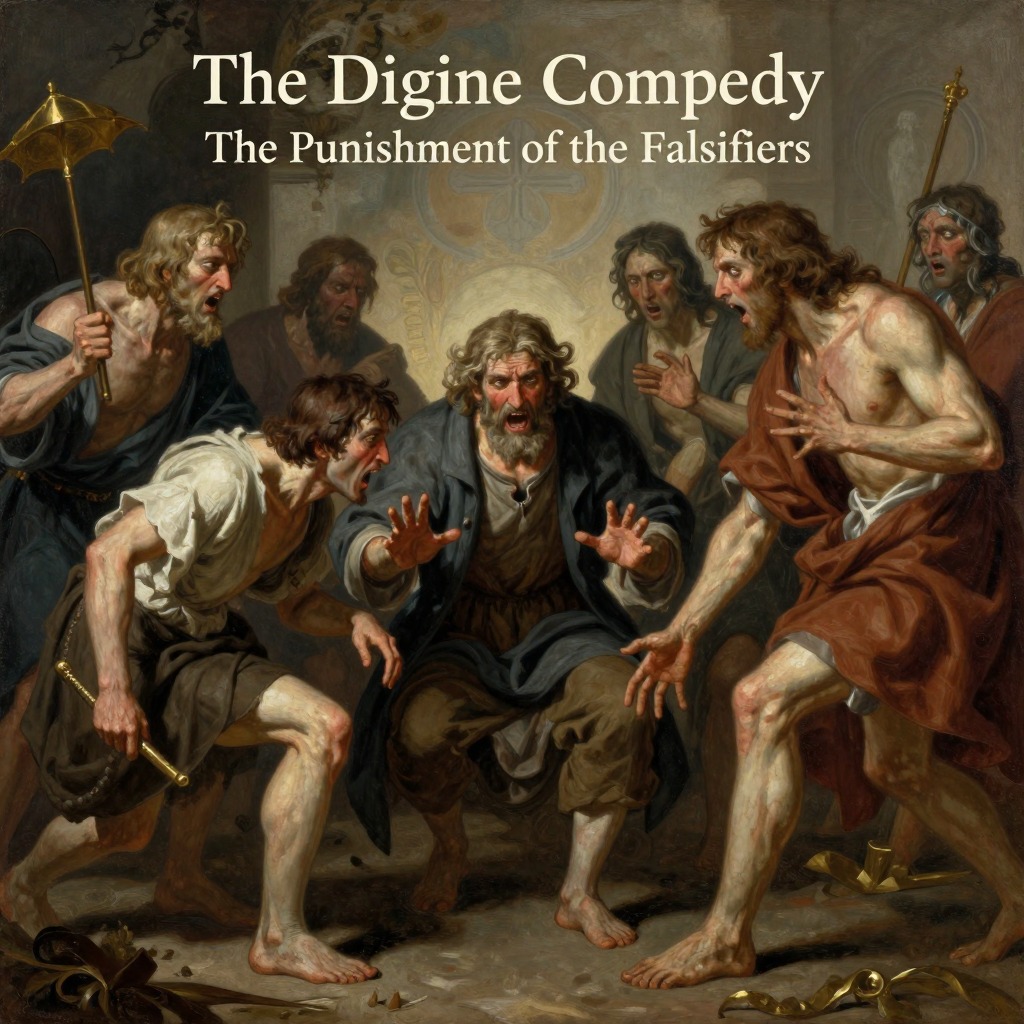
Master Adam's presence in the Tenth Bolgia is marked not only by his own suffering but by a bitter, squalid quarrel with another damned soul, Sinon of Troy, the Greek who tricked the Trojans with the wooden horse. The two engage in a vicious exchange of insults, each accusing the other of a worse crime. Sinon taunts Adam about his burning at the stake, while Adam retorts that Sinon was a false witness at Troy. The argument escalates into physical violence, with Master Adam, despite his immobility, striking Sinon in the face. This petty, undignified brawl among the damned is a striking moment in the poem, and it provokes Virgil's rare rebuke of Dante for lingering to listen. The quarrel reveals that even in Hell, the fraudulent remain locked in the same patterns of deceit and recrimination that defined their earthly lives, their malice finding no rest. It also serves as a moral lesson for the pilgrim, who is shamed by his own curiosity and reminded that a base wish to hear such disputes is itself a form of degradation.
Narrative Role and Significance
Master Adam functions in the Inferno as a representative of the falsifier, a category of sinner that Dante treats with particular contempt because fraud is an abuse of the intellect, the highest human faculty. His punishment is a vivid illustration of the principle that the sinner's own nature becomes the source of his pain. The counterfeiter, who once created a false image of value, is now himself a distorted image of a man, his body a monument to his crime. The episode also serves as a darkly comic interlude, a moment of low, grotesque humor that contrasts with the more solemn encounters of the poem. The quarrel with Sinon, in particular, shows the damned as petty and spiteful, stripped of all dignity. Through Master Adam, Dante demonstrates that the sin of fraud not only corrupts the social order but also destroys the integrity of the individual, leaving behind only a hollow, suffering shell, tormented by memory and by the company of other liars.